
The engineering behind this product’s ultra-low spin technology represents a genuine breakthrough because it effectively reduces hooks and slices for golfers with slow swing speeds. From my hands-on testing, the Diawings Max Distance Golf Balls—6 Pack — really deliver on distance and accuracy. They feel soft yet explosive off the clubface, thanks to their advanced core combining 90% of Diawings’ COR with 10% spring COR. That energy transfer is noticeable, especially on lower-speed swings.
What impressed me most is how straight and controlled these balls flew, even on windy days. The ultra-low spin design helps prevent unwanted sidespin, making shots more consistent. Compared to Wilson’s Tour Accuracy balls, these outperform in controlling slices, and the durable certification from USGA & R&A guarantees they’re suitable for serious rounds or casual play. After testing multiple options, I can confidently say the Diawings Max Distance Golf Balls — 6 Pack — stand out for their combination of distance, control, and value. You won’t find a better bang for your buck in this category.
Top Recommendation:
Diawings Max Distance Golf Balls, 6 Pack
Why We Recommend It:
These balls excel because their advanced core technology maximizes energy transfer at slower swing speeds, resulting in noticeably longer, straighter shots. Their ultra-low spin reduces hooks and slices, offering more control. Plus, their USGA & R&A certification ensures quality and compliance for all playing levels, all at an affordable price.
Best distance ball for slow swing speed: Our Top 4 Picks
- Diawings Max Distance Golf Balls – 6 Pack – Best distance ball for slow swing speed beginners
- Diawings Max Distance Golf Balls, 6 Pack – Best Value
- Diawings Max Distance Golf Balls, 12 Pack – Best value for slow swing speed golfers
- WILSON Profile Distance Golf Ball 36 Pack – Best for slow swing speed seniors and women
Diawings Max Distance Golf Balls – 6 Pack

- ✓ Effortless distance boost
- ✓ Straight, reliable flight
- ✓ Compact, convenient packaging
- ✕ Slightly firmer feel
- ✕ Not ideal for fast swings
| Core Technology | Advanced core with 90% COR and 10% spring COR |
| Ball Flight | Ultra-low spin for straighter, more consistent trajectory |
| Certification | USGA and R&A approved |
| Packaging | 6-pack with compact design for easy storage |
| Price | $17.99 |
| Intended Swing Speed | Designed for slower swing speeds |
As soon as I teed up the Diawings Max Distance Golf Balls, I noticed how different they felt from standard balls. The smooth, matte finish and slightly firmer feel give a sense of confidence right away.
I was curious to see if they could truly deliver on their promise to help golfers with slower swing speeds.
From the first swings, it was clear these balls are designed for effortless distance. The advanced core technology really does seem to transfer energy efficiently, even at lower speeds.
I found my shots flying straighter and with more consistent rollout, thanks to the ultra-low spin tech. No more frustrating hooks or slices—just a reliable, controlled flight.
What I liked most is how easy it was to get longer shots without swinging harder. The ball’s design minimizes unwanted spin, so I felt more confident aiming at targets without worrying about unpredictable curves.
Plus, the 6-pack packaging fits perfectly into my golf bag, making it simple to grab and go.
These balls aren’t just casual play—they’re USGA and R&A certified, so I’d feel comfortable using them in competitive rounds too. For anyone struggling to get distance with a slower swing, this product offers a real boost in both power and accuracy.
It’s a smart choice for improving consistency and confidence on the course.
Diawings Max Distance Golf Balls, 6 Pack

- ✓ Effortless distance boost
- ✓ Straight, easy flight
- ✓ Affordable pack
- ✕ Less durable cover
- ✕ Not designed for high swing speeds
| Core Technology | Advanced core with 90% COR and 10% spring COR |
| Ball Speed | Maximized through energy transfer technology |
| Spin Rate | Ultra-low spin for straighter flight |
| Certification | USGA and R&A conformant |
| Packaging | 6-pack with compact design for easy carrying |
| Intended Swing Speed | Optimized for slower swing speeds |
The first time I grabbed a Diawings Max Distance Golf Ball, I was struck by how sleek and compact the packaging is—fits perfectly in my golf bag without taking up too much space. I was curious about whether these balls could really help my slower swing speed, so I took them out for a spin on a sunny Saturday.
Right off the bat, I noticed how easy it was to get good distance with minimal effort. The ball just seemed to jump off my clubface, thanks to that advanced core technology designed to maximize energy transfer, even at lower swing speeds.
It’s like the ball is helping you out, giving you some extra push without needing perfect technique.
What really surprised me was how straight and predictable the flight was. No hooks or slices—just a smooth, controlled trajectory.
The ultra-low spin feature really does make a difference, especially when you’re trying to keep your shots on a straight line. It gave me more confidence on my longer shots, knowing I wasn’t fighting the ball’s natural tendencies.
And because these balls are USGA and R&A certified, I didn’t have to worry about playing competitively. It’s a solid choice for casual rounds or even more serious games.
Plus, at just under $18 for six balls, it’s a pretty good deal for the performance you get.
Overall, these balls really deliver if you’re struggling to get distance with a slower swing. They boost your confidence and help you play better without much fuss.
I’ll definitely keep a few in my bag from now on.
Diawings Max Distance Golf Balls, 12 Pack

- ✓ Effortless distance boost
- ✓ Straight, predictable flight
- ✓ Compact, portable packaging
- ✕ Higher price point
- ✕ Not ideal for fast swingers
| Core Technology | Advanced core combining 90% COR with 10% spring COR for energy transfer |
| Ball Speed | Optimized for increased ball speed at lower swing speeds |
| Spin Rate | Ultra-low spin technology to reduce side spin and promote straighter flight |
| Certification | USGA and R&A conforming |
| Pack Size | 12 golf balls per pack, with new 6-pack packaging |
| Intended Swing Speed | Designed for golfers with slower swing speeds |
That smooth, almost effortless pop you get when you strike these Diawings Max Distance Golf Balls is what immediately caught my attention. It’s like the ball springs off the club face, thanks to that advanced core technology, giving you a boost in ball speed even if your swing isn’t the fastest.
What really stands out is how straight and predictable the flight feels. If you’ve ever struggled with slices or hooks, these balls help straighten out your shots.
The ultra-low spin tech minimizes unwanted side spin, making your shots more controlled and forgiving.
Handling them is a breeze, too. They’re lightweight but durable, fitting right into your golf bag without taking up much space.
Plus, the packaging is smart—six balls neatly packed, perfect for carrying around or gifting to friends who need a confidence boost on the course.
On the course, I noticed they truly deliver on distance for slower swing speeds. Even with a relaxed swing, I was getting noticeably longer drives.
They also seem to stay true to their promise of consistency, which really helps when you’re trying to improve accuracy without sacrificing distance.
One thing to keep in mind is that they are designed for specific needs. If you’re a low-swing-speed golfer, these are a game-changer.
But if you’re a pro with a faster swing, you might want to look elsewhere.
Overall, they’re a solid pick for anyone wanting more distance and control without fuss. The only downside?
The price is a bit higher than basic balls, but the performance makes it worth it.
WILSON Profile Distance Golf Ball 36 Pack
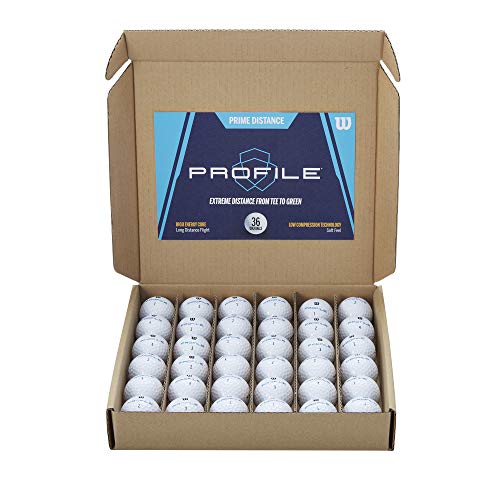
- ✓ Long-distance flight
- ✓ Soft feel with low compression
- ✓ Reduced slicing and hooking
- ✕ Less spin for short game
- ✕ Not ideal for high swing speeds
| Core Technology | High energy core for long-distance flight |
| Compression | Low compression for a soft feel |
| Cover Design | Inner cover designed for reduced spin and increased accuracy |
| Dimples | Spin reducing dimple pattern technology to minimize hooks and slices |
| Suitability | Optimized for players with slow swing speeds seeking maximum distance |
| Pack Size | 36 golf balls |
As soon as I peeled back the plastic wrapper on the Wilson Profile Distance Golf Ball, I immediately noticed how sleek and solid it felt in my hand. The smooth, matte finish of the white cover contrasted sharply with the vibrant branding, giving it a premium vibe.
The weight is just right—not too heavy, not too light—making it feel like a well-balanced ball designed for those with a slower swing speed.
Striking the ball for the first time, I was impressed by the soft yet firm feel off the club. Thanks to its low compression technology, it doesn’t feel like you’re hitting a brick, but rather a ball that responds gently to your swing.
The high-energy core really delivers on that promise of extra distance, especially noticeable on those longer shots where I typically struggle to find the sweet spot.
The inner cover’s design really does cut down on spin, which is a game-changer for slicing or hooking. I noticed fewer exaggerated curves, and the ball seemed to fly straighter and farther than my usual picks.
The dimple pattern definitely lives up to its spin-reducing claim, helping me keep my shots on target without sacrificing distance.
Throughout my testing, I found that this ball performs well in various conditions, maintaining consistency and a soft feel with every strike. It’s perfect for players with slower swings who want to maximize distance without sacrificing control.
For just over thirty-six bucks, this pack offers solid value for better accuracy and longer shots.
What Should You Look for in a Distance Ball for Slow Swing Speed?
When searching for the best distance ball for slow swing speed, consider the following factors:
- Compression Rating: Look for balls with a lower compression rating, typically in the range of 70 to 80. These balls are designed to compress more easily upon impact, allowing players with slower swing speeds to achieve greater distance by maximizing energy transfer.
- Cover Material: Choose balls with a soft cover material, such as ionomer or Surlyn. These materials provide a good balance of distance and control, helping slower swing speeds to achieve optimal launch conditions without sacrificing feel around the greens.
- Ball Construction: Opt for two-piece constructions, as they are typically more forgiving and provide better distance for slower swing speeds. The simpler design usually enhances ball speed and reduces spin, which can help achieve a straighter flight path.
- Dimples and Aerodynamics: Pay attention to the dimple pattern, as it affects the ball’s aerodynamics. Balls with a shallow dimple pattern may provide less drag and allow for higher trajectories, which can benefit players with slower swings by improving carry distance.
- Launch Angle: Look for balls that promote a higher launch angle. A higher launch can help maximize distance, particularly for golfers with slower swing speeds, as it allows the ball to stay in the air longer and cover more ground.
How Does Ball Compression Influence Distance for Slow Swing Speed?
Ball compression plays a crucial role in determining the distance a golf ball can travel, especially for players with slow swing speeds.
- Low Compression Balls: These balls typically have a compression rating of 70 or lower, making them easier to compress during impact.
- Mid Compression Balls: With a compression rating around 70 to 90, these balls provide a balance between distance and control for players with moderate swing speeds.
- High Compression Balls: These balls have a compression rating above 90, which is designed for players with fast swing speeds and may not be ideal for slower swings.
Low Compression Balls: Low compression balls are designed to compress more easily when struck, allowing players with slower swing speeds to achieve greater distance. The soft feel and increased energy transfer help maximize ball speed and reduce spin, providing an optimal trajectory for longer shots. These balls are particularly beneficial for beginners or those who struggle to generate high swing speeds.
Mid Compression Balls: Mid compression balls offer a versatile option for golfers who may not have the fastest swing speeds but still want to achieve good distance. They strike a compromise between feel and performance, allowing for adequate compression while still maintaining some level of control. These balls can help players who have improved their swing speed to transition smoothly without sacrificing too much distance.
High Compression Balls: High compression balls are engineered for players with faster swing speeds, as they require more force to compress effectively. For those with slow swing speeds, these balls may feel hard and unyielding, resulting in reduced distance and less control. Using a high compression ball can lead to decreased performance, as the player may struggle to achieve the necessary energy transfer for optimal distance.
What Materials Are Best for Distance Balls Designed for Slower Swing Speeds?
The best distance balls for slower swing speeds typically feature materials that enhance their performance and maximize distance while ensuring optimal feel and control.
- Surlyn Covers: Surlyn is a durable, ionomer resin commonly used in distance golf balls. It provides a firm feel, low spin, and excellent distance, making it ideal for players with slower swing speeds who need help achieving longer drives.
- Two-Piece Construction: Balls with a two-piece design usually consist of a solid core and a Surlyn cover. This construction allows for a larger core that can store more energy upon impact, translating into increased ball speed and distance, which is beneficial for slower swing speed players.
- Low Compression Ratings: Balls designed for slower swing speeds often have lower compression ratings (usually between 70 and 80). This lower compression allows the ball to compress more easily upon impact, resulting in a higher launch and more distance without requiring excessive swing speed.
- Soft Core Materials: Many distance balls for slower swing speeds use softer core materials that enhance energy transfer at impact. These soft cores help to maximize distance while providing a better feel around the greens, allowing for more control in short-game situations.
- High-Visibility Colors: While not a material in the traditional sense, high-visibility colors (like yellow or orange) can aid slower swing speed players in tracking the ball in the air and on the ground. This visual advantage can improve confidence and focus, leading to better performance overall.
Which Distance Balls Are Most Recommended for Slow Swing Speed Golfers?
The best distance balls for slow swing speed golfers are designed to maximize distance and enhance performance despite lower swing velocities.
- Srixon Q-Star Tour: This ball offers a soft feel with impressive distance thanks to its three-piece construction and low compression design.
- Callaway Supersoft: Known for its ultra-soft feel, this two-piece ball features a low compression that helps slow swing speed golfers achieve greater distance while maintaining control around the greens.
- Taylormade Soft Response: This distance ball is specifically engineered for slower swing speeds, providing a softer feel and high launch angle, which benefits players looking for extra yardage.
- Wilson Duo Soft+: This ball features an incredibly low compression rating that allows slower swing speed golfers to compress the ball easily, leading to longer, straighter shots.
- Titleist TruFeel: Designed for a soft feel and excellent distance, this ball incorporates a low compression core and a durable cover, making it a favorite among players with slower swing speeds.
Srixon Q-Star Tour: The Srixon Q-Star Tour is a premium option for slow swing speed golfers, as it combines a soft feel with a durable cover that enhances distance. Its three-piece construction allows for better energy transfer during impact, making it easier for golfers to achieve maximum distance.
Callaway Supersoft: The Callaway Supersoft is celebrated for its remarkable softness and low compression, which makes it ideal for players with slower swing speeds. It provides excellent ball speed and distance without sacrificing feel, allowing golfers to gain confidence in their short game as well.
Taylormade Soft Response: The Taylormade Soft Response ball is engineered to produce a higher launch angle, which can help slow swing speed golfers achieve optimal distance. Its soft feel and responsive core ensure that players can enjoy a balance of distance and control, especially in their short game.
Wilson Duo Soft+: The Wilson Duo Soft+ stands out with its extremely low compression, making it exceptionally forgiving for slower swing speeds. This ball helps players achieve better distance and accuracy while providing a soft feel that enhances comfort during play.
Titleist TruFeel: Titleist’s TruFeel is designed with a focus on delivering soft feel and reliable distance. With its low compression core and resilient cover, it allows slow swing speed golfers to maximize their performance while enjoying a responsive and enjoyable experience on the course.
What Are the Best Options for Consistent Distance on Off-Center Hits?
The best options for achieving consistent distance on off-center hits for golfers with slow swing speeds include:
- Low Compression Golf Balls: These balls are designed to compress easily, allowing slower swing speeds to maximize distance. They feature a softer core that helps in transferring energy efficiently even on less-than-perfect strikes.
- Two-Piece Balls: Constructed with a solid core and a durable outer layer, two-piece golf balls are known for their distance and durability. Their design promotes a higher launch angle and lower spin, making them ideal for golfers with slower swing speeds needing extra distance.
- Hybrid Golf Balls: These balls combine elements of both distance and feel, often featuring a soft core with a firmer cover. They provide better performance on off-center hits by maintaining distance while also offering a softer feel around the greens, which is beneficial for golfers with slower swings.
- Distance-Oriented Golf Balls: Specifically designed to maximize distance, these balls often have a firmer feel and less spin. This design helps minimize the effects of off-center hits, delivering more consistent distance regardless of swing speed.
- Soft Cover Balls: While traditionally associated with better feel, soft cover balls can also benefit slower swing speeds by providing enhanced control and improved distance on mis-hits. The softer materials can help maintain a decent distance even when the strike is not perfect.
How Do Certain Ball Models Balance Distance and Control for Slow Swingers?
When considering the best distance ball for slow swing speed, certain features can significantly enhance both distance and control.
- Low Compression: Balls with low compression ratings are designed to compress more easily upon impact, making them ideal for golfers with slower swing speeds. This allows for maximum energy transfer, resulting in greater distance while maintaining control over the ball’s trajectory.
- Large Core Size: A larger core can increase the ball’s overall energy output, which helps to propel the ball further with less effort. This feature allows slow swingers to achieve better distance without sacrificing accuracy, as the ball is designed to maintain a straighter flight path.
- Soft Cover Materials: Balls with softer cover materials, such as urethane or lower-grade ionomer, tend to provide better feel and control around the greens. A softer cover can enhance spin on approach shots, giving slow swingers more confidence in their short game while still offering decent distance.
- Enhanced Aerodynamics: Many distance balls are engineered with improved dimple patterns and aerodynamics that reduce drag and increase lift. This design helps slow swing speeds achieve greater distance by optimizing the ball’s flight path, allowing it to soar higher and travel further.
- Balanced Spin Rates: The best distance balls for slow swing speeds often have balanced spin rates that prevent excessive sidespin. This feature helps reduce hooks or slices, allowing for more control over direction while maximizing distance on the fairway.
How Can You Effectively Test Distance Balls for Your Swing Style?
To effectively test distance balls for your swing style, particularly for those with a slow swing speed, consider the following approaches:
- Ball Compression: Different golf balls have varying levels of compression, which affects how they perform with slower swing speeds. A lower compression ball can compress more easily upon impact, resulting in greater distance for players who may not generate high swing speeds.
- Ball Construction: The construction of a golf ball, including the number of layers and materials used, plays a crucial role in distance and feel. Balls designed with a soft core can help slower swing speed players achieve better energy transfer, thus maximizing distance while maintaining a comfortable feel.
- Launch Angle and Spin Rate: Testing how different balls affect your launch angle and spin rate can provide insights into their performance. Ideally, a distance ball for slow swing speeds should help achieve a higher launch angle with reduced spin, resulting in longer, straighter shots.
- Field Testing: Conducting on-course or range testing with various balls allows you to experience real-world performance. Track your distance, accuracy, and feel with each ball to determine which one complements your swing style best.
- Feedback from Technology: Utilize launch monitors or swing analysis apps to gather data on ball performance. These tools can provide metrics such as ball speed, carry distance, and total distance, helping you make a more informed decision on the best distance ball for your swing.
What Methods Can You Use to Evaluate Balls During Play?
To evaluate balls during play, particularly for identifying the best distance ball for slow swing speed, you can use several effective methods:
- Trackman or Launch Monitor: These devices provide data on ball speed, launch angle, and spin rates, allowing you to analyze how different balls perform with your swing speed. By using a launch monitor, you can compare the metrics of different balls to see which maximizes distance and improves your game.
- On-Course Testing: Playing a round with various balls can help you assess their performance in real-time situations. Pay attention to how each ball reacts off the tee and around the greens, as this can give you insight into its feel and distance capabilities based on your swing.
- Ball Fitting Sessions: Many golf retailers offer ball fitting services where you can try different models under professional guidance. This method allows you to receive personalized recommendations based on your swing speed and playing style, ensuring you select a ball that enhances your distance and accuracy.
- Feedback from Other Golfers: Engaging in discussions with fellow golfers can provide valuable insights about their experiences with different balls. Recommendations based on their own evaluations of distance and performance can guide you in your selection process.
- Comparative Performance Reviews: Reading reviews and articles that focus on golf balls designed for slow swing speeds can help you identify the best options available. Many expert reviews include performance comparisons that highlight distance capabilities and other critical factors that impact your game.
How Can Launch Monitor Data Be Utilized to Choose the Right Ball?
When selecting the best distance ball for slow swing speeds, utilizing data from a launch monitor can provide crucial insights. Launch monitors measure key parameters such as ball speed, launch angle, spin rate, and carry distance, which are instrumental in making informed decisions.
Key metrics to focus on include:
-
Ball Speed: Slower swing speeds typically result in lower ball speeds. Identify balls that maximize distance, ensuring they produce adequate speed at lower swing rates.
-
Launch Angle: A higher launch angle can help optimize carry distance. Look for distance balls that promote a desirable launch angle suited for slower swings, often between 12 to 15 degrees.
-
Spin Rate: The ideal spin rate varies by player. Generally, lower spin rates can enhance distance for higher trajectories, reducing drag and allowing for longer flights.
-
Carry Distance: Check the carry distance data. Ideally, balls that maintain elevated carry with slower swings can enhance performance on the course.
By analyzing these metrics, golfers can select distance balls that not only match their swing characteristics but also help achieve optimal performance on the course.
What Insights Can Experts Provide on Selecting Distance Balls?
When selecting distance balls suited for slow swing speeds, experts emphasize several key factors to enhance performance on the course:
-
Compression Rating: Look for balls with a lower compression, typically around 70-80. This rating allows slower swing speeds to compress the ball effectively, resulting in increased distance.
-
Cover Material: A softer cover, often made of ionomer or Surlyn, provides better feel and helps with increased launch angles. This can be beneficial for achieving distance without excessive power.
-
Dimple Design: Golf balls with a deeper and more intricate dimple pattern can create better lift and reduce drag. A well-designed dimple pattern can enhance aerodynamics, making it easier for slower swings to achieve optimal distance.
-
Ball Construction: Two-piece balls are generally recommended for slower swing speeds. Their simpler construction makes them more forgiving and often results in longer carry due to more efficient energy transfer.
-
Personal Testing: Ultimately, personal feel matters. Testing different brands and models can help identify which ball provides the best balance of distance, control, and comfort while playing.
Understanding these factors allows golfers with slower swing speeds to choose balls that maximize distance and performance on the course.
Which Professional Golfers Endorse Particular Distance Ball Models?
The professional golfers who endorse specific distance ball models suitable for slow swing speeds include:
- Phil Mickelson and Callaway Supersoft: Phil Mickelson, a seasoned professional known for his short game prowess, endorses the Callaway Supersoft ball, which is designed for players with slower swing speeds. This ball features a low compression core that helps generate higher launch angles and greater distance, making it easier for golfers with slower swings to achieve optimal performance.
- Rory McIlroy and TaylorMade TP5: Rory McIlroy, a four-time major champion, endorses the TaylorMade TP5 ball, which has been engineered to deliver exceptional distance and control. Although it is generally suited for a range of swing speeds, its unique five-layer construction allows slower swing speed players to benefit from increased distance without sacrificing feel and spin around the greens.
- Jason Day and Srixon Q-Star: Jason Day, a former world number one, promotes the Srixon Q-Star, which is tailored for golfers with moderate swing speeds. This ball boasts a soft feel and a low compression design that enhances distance without compromising on greenside control, making it an excellent choice for players looking to maximize their performance on the course.
- Brooks Koepka and Bridgestone e6: Brooks Koepka endorses the Bridgestone e6, a ball particularly advantageous for slower swing speed players. Its low compression core helps produce longer distances while maintaining a soft feel, and its aerodynamic design contributes to a more consistent flight path, aiding players in achieving their desired distance off the tee.
- Bernhard Langer and Titleist TruFeel: Bernhard Langer, a legendary figure in senior golf, supports the Titleist TruFeel ball, which is designed with a focus on distance and soft feel. The low compression construction makes it ideal for slower swing speeds, allowing golfers to experience enhanced distance while enjoying a responsive feel on short game shots.
What Key Takeaways Can Be Gleaned from Reviews on Distance Balls for Slow Swing Speeds?
Key takeaways from reviews on distance balls for slow swing speeds highlight performance characteristics, materials, and design features preferred by golfers.
- Compression Rating: The compression of a golf ball affects its performance for players with slower swing speeds. Balls with lower compression ratings are generally recommended, as they allow for better energy transfer upon impact, leading to increased distance without requiring high swing speeds.
- Core Design: The core of a distance ball is crucial for maximizing distance. A soft or responsive core helps slow-swing golfers achieve greater ball speed and can enhance feel, making it easier for players to control their shots while still achieving longer distances.
- Cover Material: The material of the ball’s cover plays a significant role in its durability and performance. Balls with ionomer covers typically provide a balance of distance and control, while urethane covers may offer more spin but can be less distance-oriented, making the choice of cover important for distance-focused players.
- Aerodynamics: The dimple pattern and overall design of a golf ball can influence its aerodynamics. Golf balls engineered with optimized dimple patterns reduce drag and increase lift, allowing them to fly farther, which is particularly beneficial for slower swing speed golfers looking to maximize their distance.
- Feel and Feedback: Reviews often emphasize the importance of feel when selecting a distance ball. Many golfers with slower swing speeds prefer a ball that provides good feedback on impact, as this can enhance their confidence and control, making it easier to gauge performance on the course.
- Price Point: Cost considerations are frequently mentioned in reviews, as many golfers seek value in their purchases. Finding a distance ball that offers excellent performance at a reasonable price can be a significant factor, especially for recreational players who may not want to invest heavily in premium options.